
Twenty-Two Misfortunes
Sergey Epikhodov, accomplished Moscow neurosurgeon, dies from a ruptured artery at sixty-eight, flatlining on the operating table of a premium private clinic. He wakes in the body of another Sergey Epikhodov: also a surgeon, thirty-six years old, penniless, professionally disgraced, and severely alcoholic.
According to a medical-diagnostic System that suddenly appears to him, he is in debt to the wrong kind of people, his liver is degenerating, and he is going to die. Again. In only ten days. There are no levels to grind and no monsters to slay — his progression is measured in something far more valuable: time. Eat better, gain time. Exercise, gain time. Use a lifetime of medical expertise and the System’s analyses to save lives along the way? Naturally. And doing good has its own rewards besides.
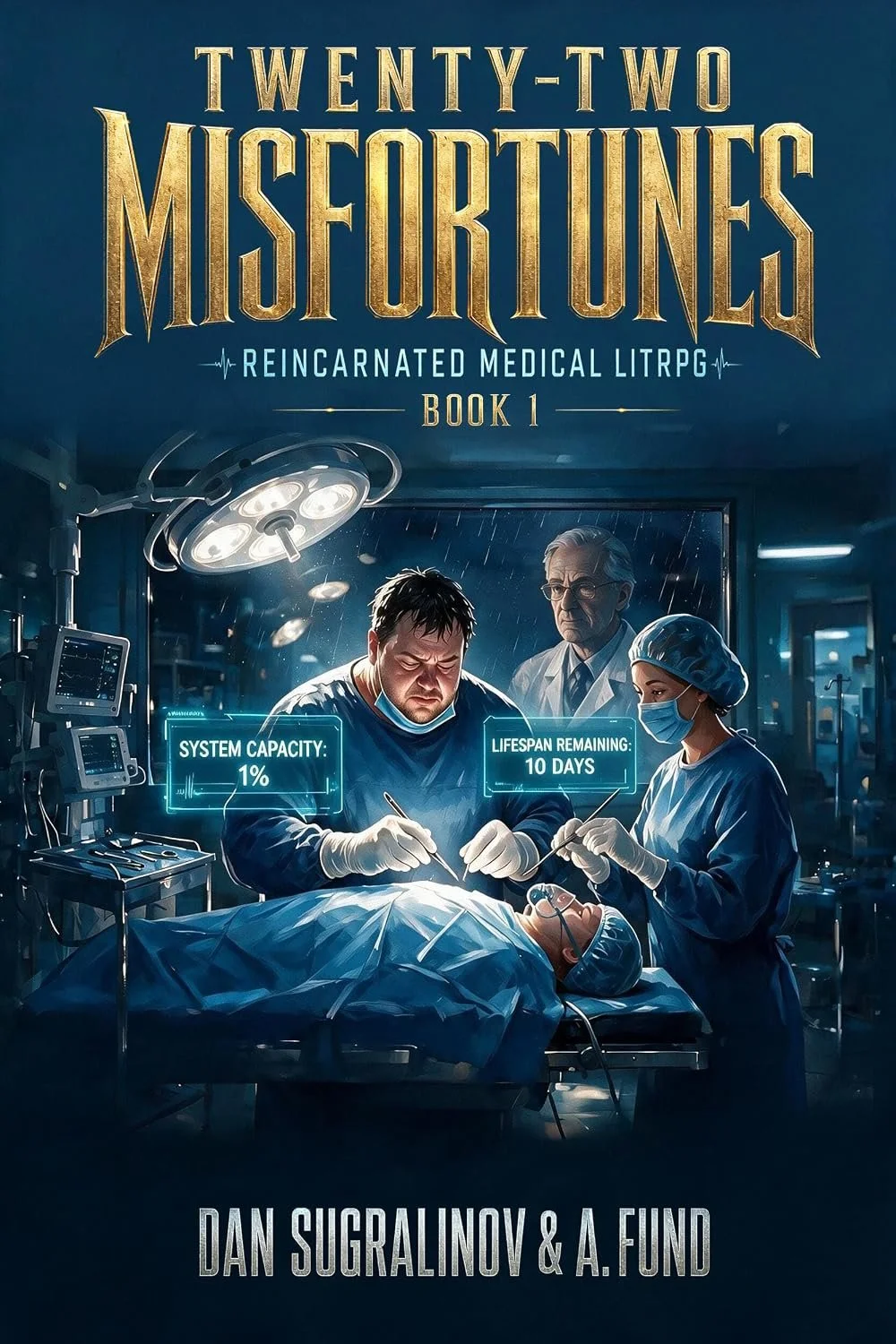
What to expect
Lifespan-based progression instead of XP. Medical problem solving with real clinical texture — co-written with a Doctor of Biological Sciences, so every medical recommendation in the book is grounded in evidence-based medicine. A slice-of-life narrative about debts, family, and second chances. Most of all — a portrait of competence as the last honest thing. Think Level Up for readers 40+.
Read the opening — Chapter 1
“BP’s dropping!” I heard it through a roar like surf.
The room tilted; light pulled into a tunnel; sound went viscous. Something hot and sticky burned my neck.
My blood. A great deal of it.
The voices around me went distant.
“Clamp! Now!”
“Epi! Pressure — zero!”
“Pulse barely palpable!”
I watched it all from the half-dark: hands flickering, droplets on gloves, the gleam of instruments. Mikhaylenko, the fat one, leaning over the table, his face twisted. Vera was pulling at the clamp, but the blood kept hammering out in pulses, synchronous with the slowing beats of my heart. I observed my own death with the clinical detachment of a man reviewing a poorly executed operation.
The air stuck in my lungs. My chest wouldn’t obey. Convulsions started, my heart slipped its rhythm, the body went foreign and heavy.
Consciousness dimmed from hypoxia — perhaps a few seconds of cerebral life remaining.
The lights over the operating table grew brighter, brighter, until they merged into a continuous white.
Last thought: rupture of the internal carotid, above the bifurcation. No chance.
And then darkness came.
* * *
Hearing returned first.
“…inadmissible disregard for elementary diagnostic protocols!” An unbearably officious voice was thundering somewhere above my head. “Do you understand, Epikhodov, that as a result of your actions we now have the third fatality this month?! The third!”
Consciousness was surfacing slowly out of murky dark, catching at scraps of reality like a drowning man at straws. Was I alive? By the look of it, yes.
Inconceivable.
Rupture of a carotid aneurysm, in my case, should have been fatal. Perhaps they’d managed an emergency intervention.
My eyelids felt leaden, but I got them open. Bright light hit the retina; I winced. White ceiling. Fluorescent tubes in metal grilles. A hospital ward? Definitely a medical facility.
“…you should have sent him for a CT immediately, not delayed the diagnosis for six hours!” the implacable voice continued.
I blinked, trying to focus. Something off. The setting was unfamiliar. Definitely not the neurosurgical department of our Moscow Roitberg Academician Clinic. Not the ICU, not intensive care either. More like — a wide, spacious office with a long table and several chairs along it.
I was… sitting? Yes, my body was indeed in a sitting position. And there was a white coat on me, but not crisp and starched the way I usually wore one — this one was crooked, like it had been hauled out of an elephant’s ass.
Across from me, leaning his massive hands on the tabletop, loomed a heavy man of about fifty-five with a heavy chin, jowls, and a balding crown, in a white coat over an expensive suit. His face was contorted with poorly contained rage, like a camel about to spit.
“Epikhodov, are you listening at all?!” he barked, and looked even more like a furious camel. “Or for you a patient’s death is such a trivial matter you can sit here and daydream?”
What was happening? The last thing I remembered was the operating room at the neurosurgical institute, the rupture of an aneurysm in my own head. And now I was in some strange place, getting reamed for — for someone else’s death?
“I’m sorry, I—” My voice came out strange, unfamiliar to me. A higher timbre, a slight rasp. That isn’t me. That isn’t me speaking.
“You drunk again?” the man hissed, his tone dropping into icy fury. The metal nameplate on his chest pocket read: Kharitonov R. I., Head of Surgical Department.
I glanced quickly around the room. Several other people in white coats sat along the long table, watching what was happening with surprise and poorly concealed glee. A medical conference? A morbidity-and-mortality review?
“I — I’m not feeling well,” I muttered, trying to buy time and make sense of things.
“Of course!” Kharitonov said with savage sarcasm. “What better moment to feel unwell, Epikhodov!”
He turned away from me and began addressing the room, pointedly, as though I weren’t in the office at all.
“You see, colleagues! When his patient was dying of peritonitis, Epikhodov wisely ignored every symptom! That’s the level of insight we’re working with!” — he stabbed a finger at the medical chart on the table. “Classic, banal appendicitis, but our great mind, our luminary of medical science, somehow managed to diagnose food poisoning! Can you imagine? Prescribed no-shpa and smecta! And sent him home! Frankly, for that he ought to receive the Nobel by force! Six hours later the patient came back with perforation, peritonitis, and septic shock! But that’s a detail! Right, Epikhodov? It was a revolution in medical science. He should’ve prescribed an enema for good measure! Just to seal the deal!”
He turned back to me and, with the room snickering, asked in a deliberately mournful tone:
“Are you a complete idiot, then?”
I said nothing, the floor going soft under me. What was this — hallucinations of a dying brain? A strange after-death vision? Coma?
“You have nothing to say.” Kharitonov shook his head bleakly and narrowed his eyes. “Wisely, Epikhodov. Because there is nothing for you to say. I warned you. Right. Clear out your desk. Now. And get ready, in the next few days, to report to the ministerial commission. They’ll want to make sure this case isn’t buried like the previous two.”
The previous two? What was he talking about?
I stood up, feeling a strange clumsiness in my own body. It was at once mine and not mine. The suit didn’t fit, chafed under the arms, bunched at the stomach, pressed oddly at the shoulders. My legs moved differently than I was used to — too heavy.
“Have your written explanation by Wednesday,” Kharitonov barked at my back. “And don’t count on Mikhail Petrovich. I’m not letting anyone cover for you on this. And I wouldn’t recommend the usual excuses, Epikhodov. This time it’s serious.”
I nodded silently and, barely keeping my balance, headed for the door, setting my feet carefully on the floor like a penguin on dry land. My head was spinning. Blood was hammering in my temples like a jackhammer. Colored circles and points drifted across my vision. I needed somewhere quiet, urgently, to figure out what was happening to me. Hallucination? Delirium? Or — something stranger?
Out in the corridor of an unfamiliar hospital, I leaned against the wall, trying to steady my breathing, fight back the nausea. Throwing up here would be the perfect end to this morning.
A young doctor passing by glanced at me with mocking contempt and wrinkled his nose, as if he’d smelled shit. I had never in my life seen such open disregard, no attempt even to hide it.
“How’d it go, Sergey Nikolayevich?” he drawled with false sympathy, stretching his lips into a rubbery smile that made him look like an astonished flounder. “Did Rostislav Ivanovich not warm to you, then?”
“I—” I caught myself, having no idea what to say. Sergey Nikolayevich? Rostislav Ivanovich? Who were they? Kharitonov? But something had to be said. “I — I have to go.”
He snorted irritably and walked on. I started down the corridor on unsteady legs, looking for the nearest restroom or any other private space. Several nurses passed me with the same hostile looks. One whispered something to another, and both of them giggled unpleasantly, glancing my way and smirking.
What in hell was happening here?
At last I found a door marked Men’s and pushed it open. The room, mercifully, was empty. I went to the sink, ran the cold faucet, splashed water on my face.
Then I looked up at the mirror.
God. Nearly tripping over my own — or no longer mine? — feet, I lurched back. My heart tried to leave my chest.
The reflection was not me.
Not Sergey Nikolayevich Epikhodov, sixty-eight years old, leading neurosurgeon at the Moscow Roitberg Academician Clinic — but some fat, slovenly middle-aged man with an unhealthy, earth-colored complexion, red inflamed eyes, three days’ stubble. I touched my forehead and chin in disbelief; the reflection copied the gesture. I pinched my own cheek; the stranger in the mirror grimaced.
Impossible. What in the actual hell.
I shoved up the sleeve of the white coat. On the fat, flabby forearm sat a vulgar Chinese-character tattoo, the lines blurred — something I’d never had in my life.
This was someone else’s body. And I was inside it.
My fingers started shaking. I drew a deep breath. Another. A third, diaphragmatic this time. By force, I beat back the panic and tried to gather my wits and think clearly. Options were limited: dream, delirium, hallucination, coma… Actually — actually, with a ruptured aneurysm, any of those was possible.
So perhaps I was lying somewhere in a padded room, wrapped in a straitjacket, and all of this was the noise of an inflamed mind.
But then something vibrated in my pocket. I felt the buzz through my whole body. A phone. A cheap smartphone in a worn, sticky case. The screen lit with a name — Ramil.
With a trembling finger, I swiped hurriedly across the smudged screen.
“Yes?” I rasped, in a hoarse voice that wasn’t mine.
“Sergey, what’d they say? How’d it go?” The voice on the other end was impatient, a snide, malicious edge underneath.
“Fine,” I forced out, trying to sound natural.
“Yeah, sure, fine!” He gave an unpleasant laugh. “Khariton already warned you they’ll have nothing left of you after the commission, buddy? I’m honestly upset for you.”
There wasn’t a single drop of upset in his voice. Just pure concentrated glee.
“I don’t have time right now,” I said. I caught myself, suddenly realizing I had no idea how I should be addressing him. By name? “We’ll talk later, Ramil.”
“Oh come on, what is it, you offended? Sure, of course, you’re our record-setter — three patients in the ground! And in a single month! And you were the one telling me I was too fixed on diagnostics! Said it was a waste of time! Well, we’ll see about that—”
I cut the line without waiting for the rest. I had no time for someone else’s mockery and griping. I needed to get out of here, fast, find somewhere quiet, think it all through again. I felt like the man who’d invented the first wheel and then spent a long time trying to figure out where to attach it.
Because this could not be happening.
I left the restroom, trying not to meet the eyes of staff passing me. Going on instinct, I made for the stairs. Down to the ground floor, right, through the automatic doors. Glass vestibule. The exit.
Finally.
Cold autumn air hit my face. I drew a deep breath and tried to clear my head.
And then, in the upper-right corner of my visual field, a faint shimmer appeared. I blinked. Trick of the light. Astigmatism. But the shimmer didn’t go. It only sharpened, took clearer shape — a translucent interface, like a fragment of a computer screen, as if text were lighting up on glass.
New host: Epikhodov, Sergey Nikolayevich, age 36.
Initiating host diagnostics…
Diagnostics complete.
Warning. Physical condition of body: critical.
Life expectancy without intervention: 3–5 months.
Pathologies detected:
— marked atherosclerosis of coronary vessels (stenosis 38%);
— hepatic steatosis, early fibrosis;
— disorders of carbohydrate metabolism (prediabetic state, insulin resistance);
— smoker’s chronic bronchitis with signs of obstruction;
— elevated blood viscosity and pro-thrombotic tendency;
— macro- and trace element levels below reference range.
Primary causes: smoking (15+ years), regular alcohol intake, irrational diet, sedentary lifestyle, poor sleep, chronic stress.
Recommendations for restoration of organ function:
1. Immediate full cessation of nicotine.
2. Full elimination of alcohol.
3. Anti-inflammatory diet.
4. Graded physical activity.
5. Sleep normalization and stress reduction.
6. Pharmacological treatment.
Projected effect with adherence:
+ (6–12) months added to life expectancy within the first 30 days.
I rubbed my eyes, but the interface didn’t go anywhere. It floated in front of me, translucent as a jellyfish, but distinctly readable.
What kind of devilry was this? A hallucination? But hallucinations did not produce structured, precise medical findings — and in formatted output, no less.
For some reason, I believed the table at once.
Quick answers
- Is this LitRPG?
- Yes — a reincarnation medical LitRPG. Progression is measured in lifespan: good habits and good deeds buy extra days of life. No VR, no monsters.
- Do I need to read the other series first?
- No — this is a brand-new standalone series, and this is Book 1.
- Where can I read it?
- In English on Amazon — Kindle ($4.99), free with Kindle Unlimited, or paperback ($14.99). In Russian on Author.Today.
- Who is A. Fund?
- Dan’s co-author — a Doctor of Biological Sciences. The medical side of the book is theirs: every recommendation the System gives is based on evidence-based medicine. In Russian, Twenty-Two Misfortunes has sold 300,000+ copies in half a year and won the Silver Electron Award 2026.